There is something particularly cruel about having to explain to a child why the people they loved are no longer coming home. Why he has lost his leg. Why he had to starve, or run behind water trucks instead of running across a football field. Why he now lives in a tent, or why he has forgotten what it feels like to turn on the television and watch SpongeBob or Tom and Jerry.
It is cruel. And yet, children understand, at least to some extent, the injustice being imposed on them and on the people around them. I believe it is human nature to sense when something is wrong. You do not need to understand politics to recognise injustice. And I can’t tell you how many children in Gaza wish they could die, praying that the moment they open their eyes, at a morning when the sun is obscured by the smoke of bombardment, to vanish from this world.
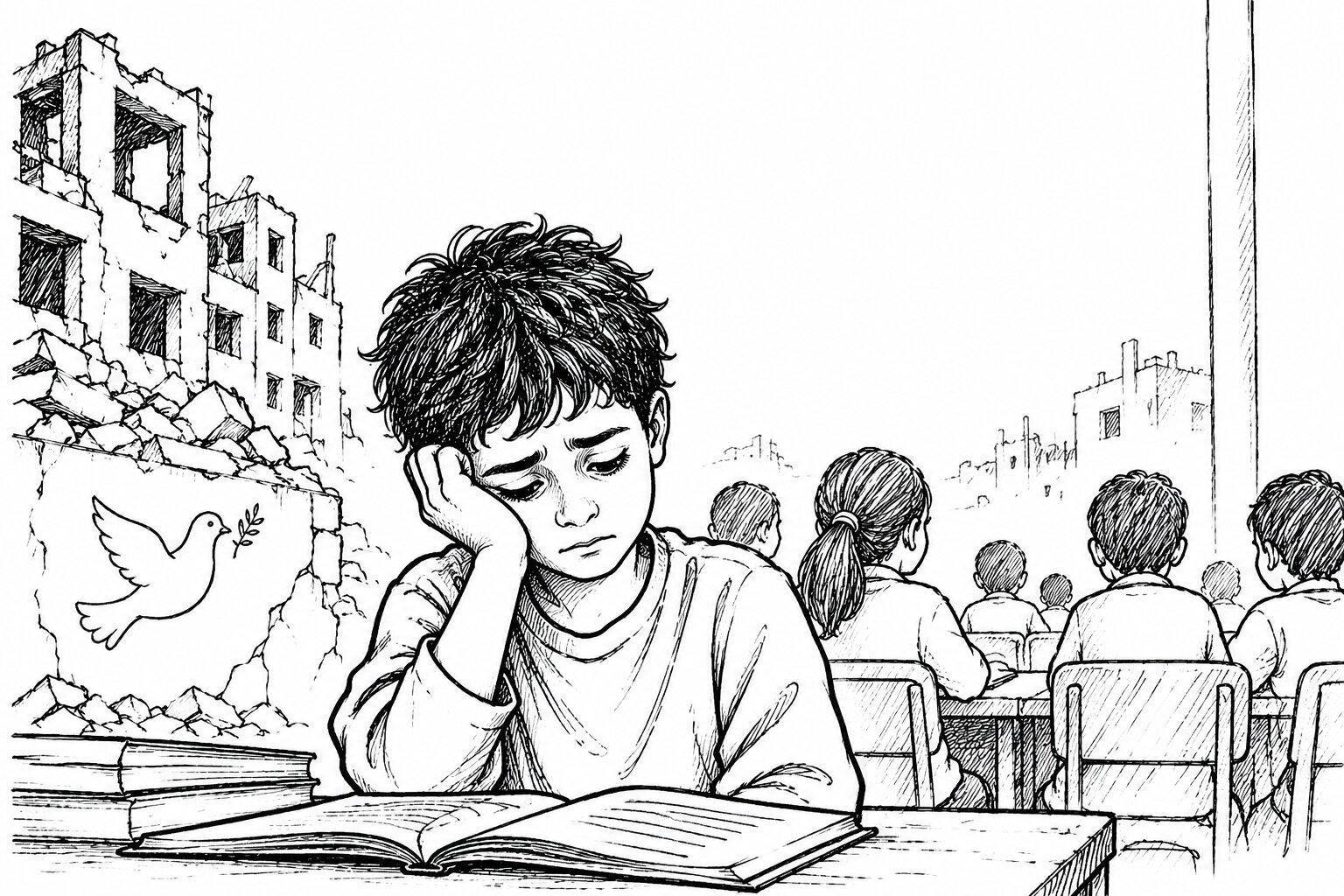
In Gaza, an entire generation of children has had its education interrupted. For three years, ordinary school life has been put on hold. I don't have data showing the extent to which children's general cognitive development has deteriorated. But I suspect we all know. You know it, I know it, and the children know it too. That their schools have been destroyed and those that remain standing have been turned into shelters, serving a purpose more immediately necessary than education: survival.
And here lies a painful contradiction. The very places where children should have been learning have become places where some have sought refuge from the conditions that have deprived them of their education.
Gaza's children might not know the map of the country being destroyed around them, the science lesson about gravity, the poetry of Mahmoud Darwish in their Arabic textbooks, or the climate of the region and the layers of the earth. But they have learned other things. They know how to write their names on their bodies so that they can be identified if they were found beneath the rubble. They know how to count the neighbours who have been killed, or calculate how many pieces of bread they have left until tomorrow.
This was the reality until community-led educational initiatives began to emerge, attempting to restore some measure of normal childhood to these children. Larger organisations followed. One such initiative is Academies of Hope, an appealing name for a series of schools established by the Gaza Children Village, an American charitable initiative led by Palestinian-American neurosurgeon Dr David Hasan.
At first glance, the initiative appears to address some of Gaza's most urgent needs. Its founder has spoken about building a village capable of accommodating thousands of vulnerable children (orphaned and displaced) and providing them with education, medical care, nutrition, and psychological support. In a place where educational infrastructure has been devastated, hundreds of thousands of children have been deprived of ordinary schooling, and families struggle to meet even their most basic needs; these services are not insignificant.
But humanitarian assistance does not exist outside politics, power, or accountability. And when its beneficiaries are children who have already lost almost everything, the responsibility of those providing that assistance becomes even greater.
The proposal, described by Hasan during a September 2026 webinar, involves recording classroom conversations and analysing them using an AI-powered system designed to identify language classified as antisemitic, hateful, or inciting. When the system identifies potentially problematic speech, an alert is reportedly sent to Hasan, who can review the material and contact the teacher for follow-up.
According to the reporting, recordings would be retained for 72 hours. The technology had reportedly been tested, with plans to introduce it across dozens of classrooms. Yet the precise timetable for implementation, the criteria used to classify speech, and whether children, their families, and teachers had been adequately informed remained unclear.
Hasan has defended the proposal as a means of ensuring that teachers follow a curriculum intended to promote peace and tolerance and prevent the glorification of violence. He has described the initiative as part of a broader effort to prevent what he calls the radicalisation of another generation.
Let me be clear: education in Palestine should not glorify the killing of civilians, nor should it be founded on religious hatred. And it was not. I am one of hundreds of thousands who were once students, and can attest to that. But wait. Are you trying to play sneaky? Or as we say in Arabic: “يدسّ السم في العسل”, to slip poison into honey?
What happens when a child asks why their parents were killed? What happens when a teacher discusses the occupation, the Nakba, Palestinian prisoners, displacement, or the destruction of their neighbourhood? What happens when a child expresses anger towards those they associate with the shattering of their family? Who decides whether that expression is an understandable response to lived experience, a historical discussion, an educational opportunity, or an indication of extremism? You? Absolutely not.
Are you going to change the Palestinian curriculum? Who gave you that authority? Do you consider yourself a humanitarian who has come to help children access education in accordance with their national curriculum, or are you bringing back old colonial agendas under the language of humanitarian assistance? Will you respect the Palestinian Authority, which has expressed concerns about this proposal? Will you listen to the people and institutions representing the children you claim to be helping? The colonisation of education is centuries old. We know this well. We know what it means when someone else assumes the right to decide what our children should learn, remember, or become. If you don’t know, we know it.
Recording classrooms and analysing conversations with artificial intelligence? This sounds like something from a dystopian prison. Could you do this to children in American schools, in the country where this organisation is based? Would you have the authority to do so? Would their parents accept continuous surveillance of their children's conversations? Or does the situation suddenly become different when the children are Palestinian, and their parents have little power to object?
Do you believe that the vulnerability of Gaza's children and their families gives you a degree of authority over them that you would never assume over children elsewhere? Is this another version of the paternalism historically imposed on Indigenous communities in the United States, where those in power claimed to know what was best for people whose voices they were unwilling to hear?
What kind of educational environment should a Palestinian child experience? One in which they are encouraged to speak, question, remember, and gradually make sense of what they have lived through? One in which teachers are trained to recognise trauma and grief and provide the psychological support a child needs? Or one in which conversations are recorded, analysed, and potentially flagged by a system whose definitions, thresholds, and interpretations are determined elsewhere? One where both children and teachers lose freedom: to ask and to answer.
Are you suggesting that teachers cannot simply be trusted to teach without being continuously observed? Is this a new form of supremacy? Is the objective to educate children, or to supervise the production of particular attitudes?
These are not theoretical questions. And they are not all questions one can ask. They are fundamental questions of child protection, privacy, educational freedom, and institutional accountability.
There is another dimension that makes Hasan's intentions and the organisation's activities even more troubling: what he said in an interview about his medical missions to Gaza in December 2023 and April 2024.
During an interview with Yalla Channel in September 2026, Hasan explicitly described his missions as having two objectives: treating wounded patients and rescuing Israeli prisoners. He spoke about how he lured children with candies to obtain intelligence from them about whether they had witnessed someone speaking differently (Israeli prisoners). These were children living through starvation and bombardment. To use their hunger and innocence as an opportunity to obtain intelligence is to treat them not as children in need of protection, but as potential intelligence assets.
Did you come to Gaza as a medical doctor, or as an intelligence agent wearing scrubs, making use of children?
This raises serious questions about whether Dr Hasan and his organisation should be entrusted with such responsibility over Palestinian children. If he was willing to approach children in the streets, offering them sweets while seeking information, what might happen to children whose classroom conversations are continuously monitored? What safeguards can guarantee that individual kids’ vulnerability will not be exploited? And who would be held accountable if it were?
There is something especially disturbing about the possibility of turning the vulnerability of orphaned and displaced children into an opportunity to recruit them as intelligence informants. It is historically documented that Palestinian children have been exposed to such challenges. The United Nations Secretary-General has recorded multiple testimonies from Palestinian children reporting attempts by Israeli forces to recruit them as informants.
Children who have lost their parents, homes, and sense of security should be among the people most protected from such practices, not among those most exposed to them, or even at risk. They are individuals with rights, dignity, and the capacity to develop their own identities. Their vulnerability creates an obligation to protect them, not an opportunity to exercise greater control over them.
Perhaps the most important question is not about this particular organisation alone. It is about the kind of humanitarian architecture now emerging around Gaza. When responsibility for essential services is concentrated in institutions with limited local accountability, the issue is no longer simply one of service delivery. It becomes a question of power: who gets to decide, who gets to supervise, and who gets to shape the lives of an entire population and generation? Gaza needs international support, but the institutions shaping Palestinian lives must remain accountable to Palestinians themselves.
Rebuilding a society means more than returning children to classrooms. It means allowing them to grow up with dignity, freedom, and the right to shape their own future. Given Palestinians' long experience of surveillance and security classifications imposed beyond their control, introducing another system of observation into children's lives cannot be treated as an ordinary educational innovation.
I want Gaza's children to encounter the world with curiosity, compassion, and freedom. But I do not want them to learn that peace requires silence, tolerance requires forgetting, or their history is an obstacle to their future.
There is a difference between protecting children from hatred and protecting an institution from uncomfortable questions; between providing humanitarian assistance and acquiring the authority to shape the minds of those receiving it.
The Gaza Children Village may be providing services children urgently need, and its founder may genuinely believe in his educational model. But good intentions cannot exempt an organisation from scrutiny.
The children of Gaza have already had too much taken from them: their homes, schools, families, safety, and much of their childhood. We should not allow reconstruction to become another opportunity to take control of their education.
Gaza's children do not need someone to manufacture a future for them. They need the freedom, protection, and dignity to build one themselves.