In the first days of January 2024, we were forced to evacuate our home and move to Rafah. Our neighbour, an elderly man and a devoted animal lover, refused to leave. He had dozens of animals to care for: birds, cats, sheep, and dogs. Two of his dogs had already been killed in airstrikes on his farm in November 2023, I think.
I should tell you something about animals during bombardment. They get terribly frightened. Their reactions are sometimes remarkably similar to those of young children. There is one scene I cannot get out of my head. This stray dog came running from a distance, terrified by the bombardment. Her limbs eventually gave way, and she collapsed, unable to stand. She was shivering. She wasn't ill or injured; she was simply frightened. Our neighbour, with his experience of dealing with animals, managed to calm her down, and eventually adopted her.
He didn't evacuate because he couldn't. He chose to stay behind with his wife and animals to face whaever uncertainity bring to him. What did he have to lose? His days were already numbered. He preferred to wait for the roof to collapse over him and his animals rather than cling to life in a tent somewhere in the streets. What kind of life could possibly await him without his animals? He would rather be dragged away from his home by the Israeli army than abandon it. Unlike us cowards. Or perhaps we did the right thing at the time. I honestly don't know.
Anyway, he took good care of this dog. He fed her like one of his own, and spent his days contemplating how he and all these creatures had ended up in such circumstances.
We left our home quite late. We were among the last families to evacuate the area, and eventually among the first to return. By the end of February, we were back. Nuseirat was still largely deserted, its streets empty of the people who had once filled them.
Thankfully, our home was still standing. It was intact, livable, and, most importantly, nothing had been stolen. We couldn't thank Allah enough. But if the house hadn't been destroyed, how had it escaped being looted?
Unfortunately, looting had become increasingly common. Abandoned houses were often stripped of their belongings, which were then resold to people who needed to rebuild their lives after losing almost everything. So how had our house survived?
The answer was waiting for us at the entrance.
When we returned, we found the dog still tied with a long robe to the door of our house. We asked our neighbour what had happened during our absence. He told us that she had been the one protecting it. She had stayed there, guarding our house and the neighbouring ones. Perhaps it was loyalty, or perhaps it was simply the familiarity and comfort she had found in the place where she had once been frightened and subsequently cared for. Whatever the reason, she had done her job, and done it well. Thanks to her, our house had remained safe from intruders.
My youngest brother began playing with her whenever he could. He fed her canned meat when we had enough, and sometimes even when we didn't. I could barely do the same. I was still working exhausting emergency shifts at Al-Aqsa Hospital, barely making it home long enough to sleep before heading back for another shift.
Then came that particular night in early March.
During the war, receiving a phone call is almost always an omen of misfortune, especially after midnight or at an unexpected hour. The moment the phone rings, adrenaline rushes through your body. You immediately fear that something terrible has happened: Allah forbid, someone has been injured, your house has been bombed, someone you know has been killed, or perhaps your entire family has been wiped out. You become accustomed to anticipating loss, in all its possible forms.
A few of my colleagues had received calls like these. I remember one colleague who was at Al-Aqsa Hospital, in the southern part of Gaza, when he received the news that his father, trapped in the northern part, had been killed in an airstrike on their family home.
Absurd! To have your family just a few miles away and yet be unable to say goodbye. To lose them without even being able to reach them. To lose them in this cold way. To receive such news in the middle of an working day, as though the world had not just ended for you.
That night, at around two in the morning, I received a call.
"They shot the dog! They shot the dog!"
I couldn't quite separate the emotional contradiction of being relieved that my family, relatives, and home were safe from the sorrow of knowing that this creature, who had been braver than us in protecting our home, was now seriously injured.
"She's lying in a pool of blood! What can we do?"
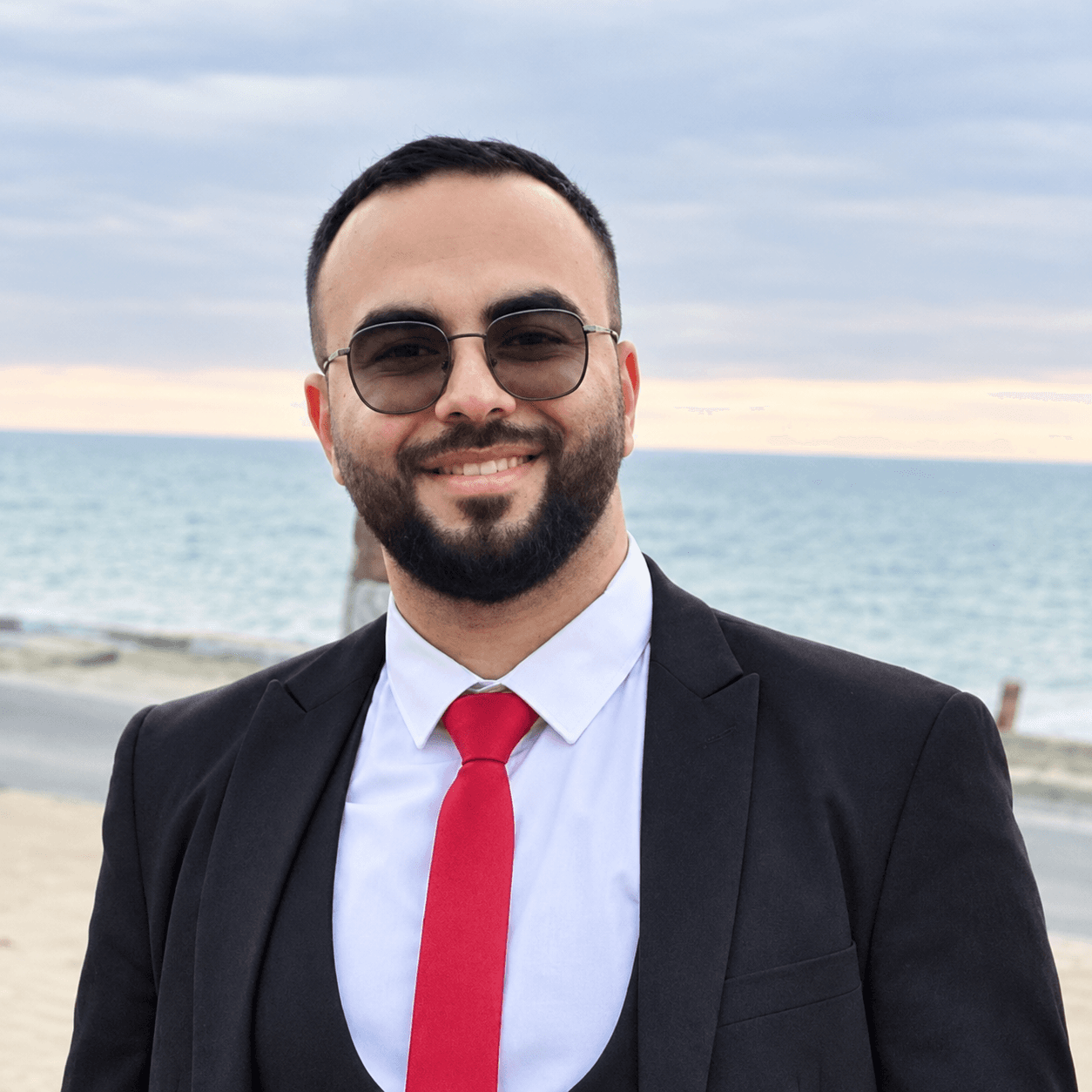
I was at the hospital, but my younger brother Mahmoud, also a doctor, was home that night. Neither of us was a veterinarian. We were human doctors. Nevertheless, he went outside and provided what amounted to basic first aid, using the supplies available to him and the little he knew about managing an injured creature, particularly one in pain and frightened of being approached.
We never knew exactly what had happened. All I was told was that a few gunshots had rung out after the sound of hurried, heavy footsteps passing through the narrow alleys of the camp. We never established who had been running through those alleys after midnight. They might have been Israeli special forces, armed robbers, or someone else entirely.
Nor could we freely ask those questions over the phone. If you don't know, you should understand that discussing anything of a military nature on the phone in Gaza is something people have learned to avoid. You always have the feeling that there is a third listener somewhere. Perhaps someone is listening, or perhaps an artificial intelligence system is running in the background, flagging certain keywords and labelling you in real time. Whether or not you can establish what is actually happening, this is how we have come to experience communication during the war.
It is a peculiar kind of deprivation: the loss of privacy, as though you are stripped naked and left in a glass room, with the knowledge that someone might be watching.
My brother couldn't tell me much beyond the dog's howling and the pool of blood beneath her. She was unable to stand. It took at least five to ten minutes before our neighbour, my family members, and a few other people nearby dared to leave their houses and get a glimpse of what had happened. They were witnessing a scene they had become terribly familiar with, except that this time the injured creature was not a human being.
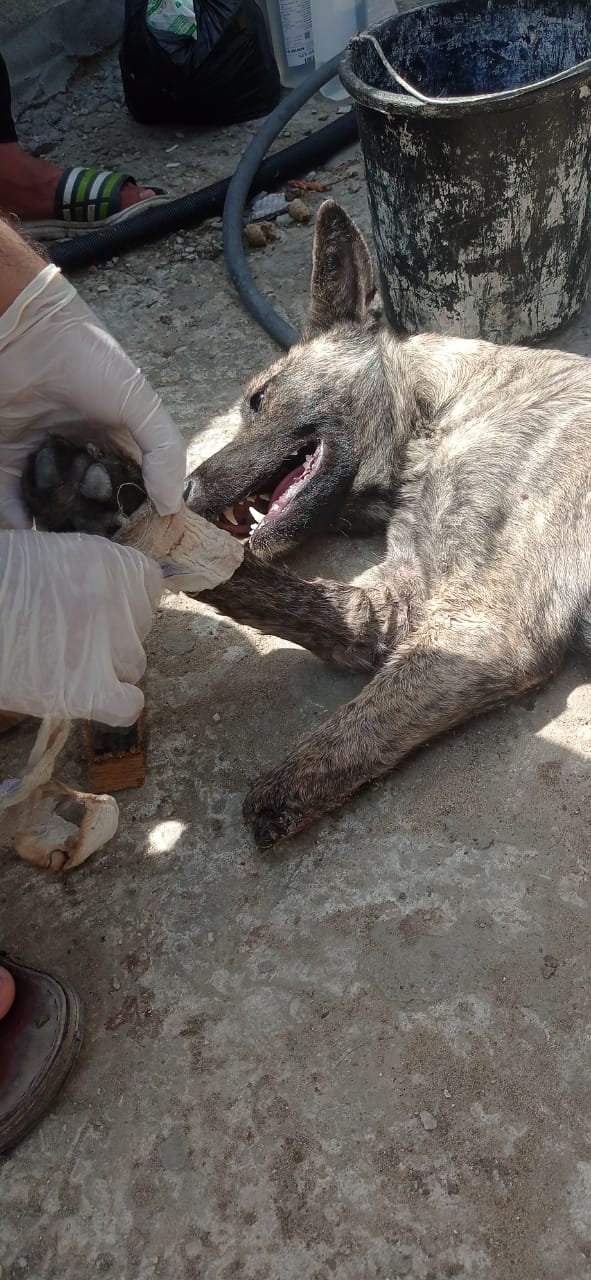
They, with my brother, tried to dress her bleeding limbs, changing the dressings repeatedly as she cried in pain. Her owner was devastated, watching his dog suffer without knowing what else he could do. Mahmoud told me that she had sustained gunshot injuries to both forelimbs and that I would have to do something when I got home the following day.
I received the call and couldn't sleep.
I had never treated an animal before. Almost all my experience involved traumatic limb injuries in human beings: our friends, our neighbours, and people brought into the hospital every day. It had become my daily routine to care for open fractures and amputations. But this time, my patient was a dog.
I wasn't a veterinarian. But, to be fair, I wasn't exactly an orthopaedic specialist either. I was a doctor who had found himself caring for some of the most severe cases among human patients, largely because of the extreme shortage of specialists and the circumstances we were working under.
Adapting to circumstances had become a necessity. In a place where access to healthcare for human beings was already severely restricted, access to veterinary care was practically nonexistent. Still, I couldn't just walk away from this poor creature.
Then I had an idea. I would search the internet for advice.
I spent some time reading about the standard management of canine limb fractures, wound care, and plaster immobilisation. Surgery was not an option, so I needed to find a way to manage her injuries with whatever I could carry home.
I packed my backpack with what I thought might get the job done: diclofenac injections, a course of penicillin, wound-dressing equipment, and plaster materials.
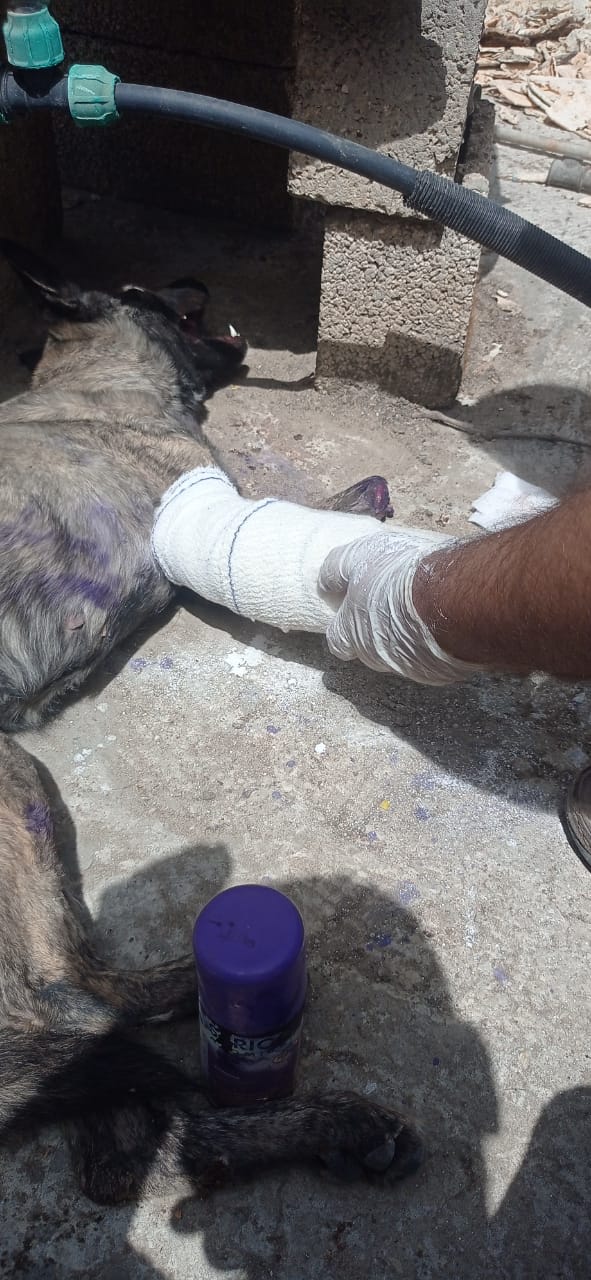
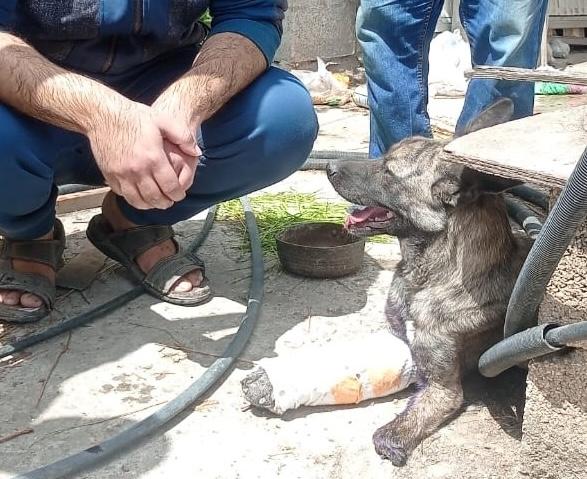
When I finally examined her, I found that her injuries were severe. She had sustained a traumatic amputation of her left forelimb and an open fracture of the right one. I couldn't arrange an X-ray, but clinically the fracture appeared comminuted.
With the help of her owner, who knew how to approach, calm, and handle animals, I began treating her. He was constantly nervous, watching over her and worrying about her pain. She would sometimes howl, and he would try to keep her still, perhaps hoping to spare her further suffering. He was frightened, too.
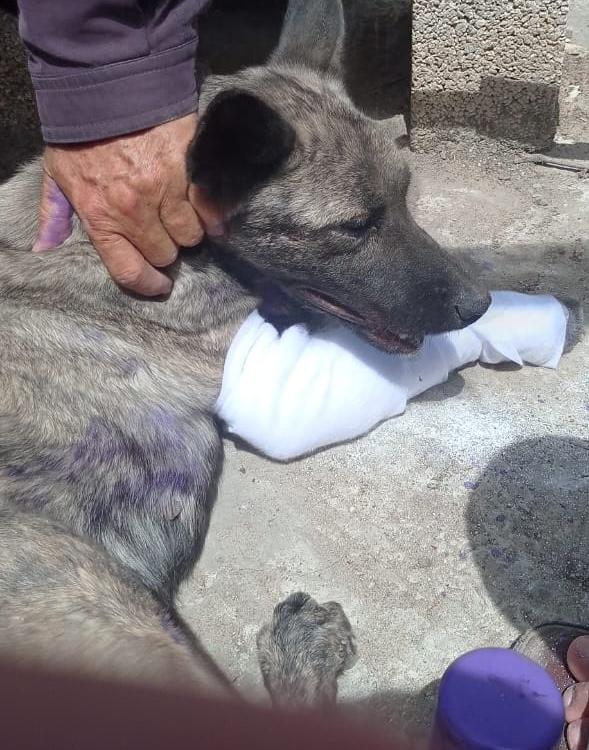
I cleaned and redressed her wounds, applied local antibiotic treatment, and immobilised the fractured limb with a plaster cast.
Her treatment, however, was far from optimal. She would eventually need a prosthesis for her amputated limb and further surgery to address the fracture in the other one. Neither service was available under the circumstances. In fact, services like these were barely available to human beings.
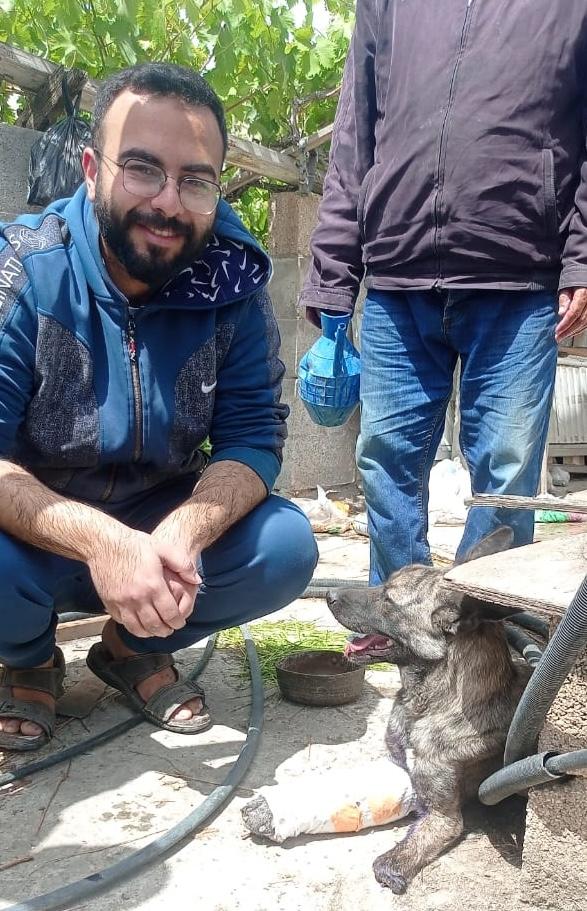
We continued looking after her as best we could for some time till she got well.
I remember being on the roof of our neighbour's house with the old man. We were not particularly safe up there. The sounds of nearby tanks and missiles were unmistakable, a constant reminder that the violence had not gone anywhere. Being under an open sky was always a risk. A flying piece of shrapnel, a random or targeted gunshot from a quadcopter, or any of the countless ways a person could be killed in those days.
There was something strangely difficult to comprehend about that moment. An elderly man, worried about his injured dog; a doctor trying to keep an animal alive using whatever supplies he could carry home from a hospital; and, all around us, a war that had made even the simplest acts of care extraordinarily difficult.
I had spent months trying to save people's limbs in a hospital overwhelmed by injuries. Now, I was trying to save the limb of a dog that had spent almost two months guarding our otherwise empty neighbourhood.
She had protected our home when we were away. Now, all we could do was try to protect her.
And she survived.
Over the following months, she gradually regained her strength and some of the joy she had lost. She learned to live with her disability. She learned to walk and hump like a bunny or kangaroo. She fought fate remarkably well.
She also survived the famine, much like the rest of us, on the bare minimum and whatever food was available to sustain a living creature in Gaza. There was little nutritional value in much of what we could find, but somehow, we all kept going.
After the ceasefire in October 2025, she even became pregnant. For a while, it seemed that life was finally offering her something beyond survival. She was going to have puppies.
But it seems fate had other plans.
She became ill and, judging by her condition, might have needed the attention of a veterinary obstetrician. Unfortunately, I am only a general doctor. There was little I could do.
After clinging to life for almost two years following her injuries, she eventually died with her fetuses.
I don't know whether to think of her as a survivor, a victim, or simply another creature whose life was shaped by circumstances far beyond her control. Perhaps she was all three. Perhabs death decided to reward her with a better afterlife and ease her life.
Her story is not particularly extraordinary by Gaza's standards. There are thousands of stories of human beings and animals trying to survive, with whatever little they have, in a place where even the most basic conditions for living have become privileges.
But I keep thinking about that dog.
We were never able to give her everything she deserved. We could barely give ourselves.
Still, for a while, we looked after one another.
And perhaps that is what I want to remember most. That she was a witness to the level of violence. the mix of hope and despair, and the lack for healthcare living creatures faces and continue to face in Gaza.